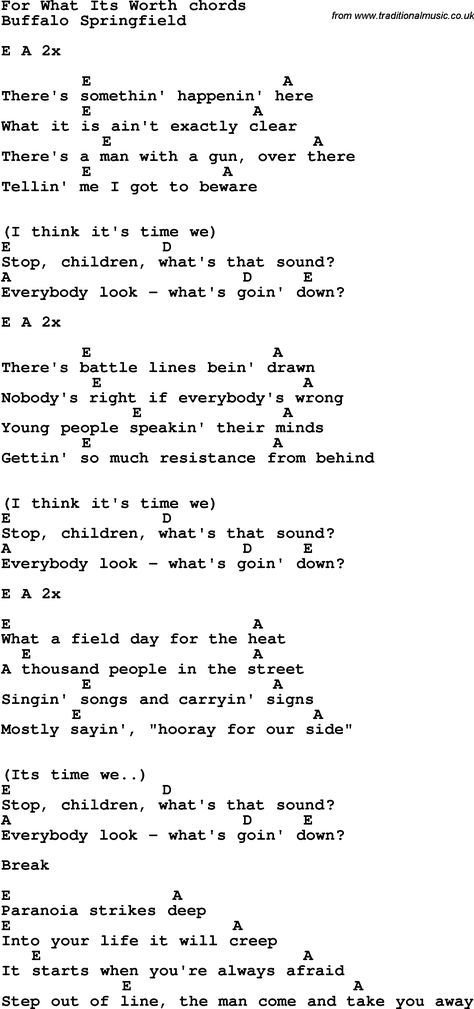
The first strum of Buffalo Springfield's "For What It's Worth" isn't just a chord progression; it's a timestamp, a potent echo from a tumultuous era that continues to resonate with timeless relevance. If you've ever felt a collective unease in the air, a sense of "something happening here" that's just out of clear focus, you've connected with the heart of this iconic track. Learning "'For What It's Worth' Lyrics, Chords, and Guitar Tabs" isn't just about mastering a song; it's about channeling a pivotal moment in cultural history through your fingertips and voice.
This isn't just a technical breakdown; it's your comprehensive roadmap to understanding, playing, and truly feeling this enduring protest anthem. Get ready to peel back the layers of its deceptively simple structure and discover the nuances that make it unforgettable.
At a Glance: What You'll Discover
- The Song's Core Message: Unpacking the poignant lyrics and historical context that give "For What It's Worth" its enduring power.
- Essential Chords: Mastering the fundamental E, A, D, and G chords that form the song's backbone.
- Decoding the Guitar Tabs: A detailed breakdown of the iconic intro harmonics, main riffs, and solo sections.
- Key Guitar Techniques: Learn natural harmonics, hammer-ons, bends, and vibrato as applied in the song.
- Full Song Structure: A clear, section-by-section guide to playing the entire track from start to fade-out.
- Tips for Authentic Play: How to capture the original feel and dynamics of Stephen Stills' masterful guitar work.
More Than Just Notes: The Story Behind the Strums
Before we dive into the fretboard, it's crucial to understand the spirit of "For What It's Worth." Written by Stephen Stills in response to a curfew and violent protests on the Sunset Strip in 1966, the song became an unwitting anthem for a generation grappling with social upheaval, free speech, and the burgeoning counter-culture movement. Its power lies in its observational, almost lamenting tone, rather than an angry, accusatory one. It asks questions, highlights observations, and invites listeners to "look what's going down."
This context isn't just trivia; it informs how you should approach playing and singing the song. The guitar parts, while seemingly straightforward, carry a certain tension and melancholic introspection. The vocals, delivered by Richie Furay, have a weary wisdom that belies the band members' youth. Keep this in mind as you start to internalize the music – it's a conversation, a warning, and a call to awareness, all wrapped in a beautifully crafted folk-rock package.
Tuning Up: The Foundation
First things first, grab your acoustic or electric guitar and ensure it's in Standard tuning (E-A-D-G-B-e). This is non-negotiable for accurately playing "For What It's Worth." A quick check with a tuner will save you headaches down the line.
The Heartbeat: "For What It's Worth" Lyrics Unpacked
The lyrics are the soul of this song, a series of poignant observations that feel as relevant today as they did in the '60s. They paint a picture of confusion, division, and a quiet sense of alarm.
Key Themes and Phrases:
- Observation and Unease: "There's somethin' happenin' here / But what it is ain't exactly clear." This opening instantly sets a tone of cautious vigilance.
- Societal Conflict: "There's battle lines being drawn." This line powerfully captures the polarization and division prevalent during the era, and sadly, in many times since.
- Youth Expression vs. Authority: The song touches on public demonstrations and resistance: "A thousand people in the street / Singin' songs and a-carryin' signs / Mostly sayin' 'hooray for our side'." It highlights the clash when youthful protests meet societal pushback.
- Pervasive Fear: "Paranoia strikes deep / Into your life it will creep." Stills masterfully captures the psychological toll of uncertainty and suspicion that often accompanies social unrest.
- Call to Awareness: The repeated refrain serves as an urgent plea: "I think it's time we stop / Children, what's that sound? / Everybody look what's going down." This isn't just a catchy chorus; it's a direct challenge to complacency.
When you sing these words, try to embody that observational, slightly melancholic, but ultimately insistent tone. It’s not about shouting; it’s about a measured, thoughtful plea for attention.
Getting a Grip: The Core Chords
"For What It's Worth" primarily revolves around a few open position chords. If you're familiar with the basics, you're already halfway there.
Standard Chords Used:
- E Major: The home base for the verse.
e|-0-|
B|-0-|
G|-1-|
D|-2-|
A|-2-|
E|-0-| - A Major: The primary companion to E in the verse.
e|-0-|
B|-2-|
G|-2-|
D|-2-|
A|-0-|
E|-x-| - D Major: Introduced in the chorus.
e|-2-|
B|-3-|
G|-2-|
D|-0-|
A|-x-|
E|-x-| - G Major: The final chord of the main chorus progression.
e|-3-|
B|-0-|
G|-0-|
D|-0-|
A|-2-|
E|-3-|
Practice smooth transitions between these chords. The song isn't fast, but the changes need to be clean to maintain its hypnotic groove.
Finger by Finger: Decoding the Guitar Tabs
Here's where we get into the nitty-gritty of Stephen Stills' distinctive guitar work. Remember, the key is precision and feel, not just hitting the right notes.
The Iconic Intro: Natural Harmonics
The intro is instantly recognizable, built on ethereal natural harmonics. These are played by lightly touching the string directly over the fret wire (not pressing down) and then plucking the string, lifting your finger immediately after plucking.
e|---------------------------------|
B|---------------------------------|
G|---------------------------------|
D|---------------------------------|
A|---------------------------------|
E|-<12>----<7>---------------------|
<12>: Play a natural harmonic on the 12th fret of the low E string.<7>: Play a natural harmonic on the 7th fret of the low E string.
Repeat this sequence. The timing is crucial here – let each harmonic ring out clearly. This sets a very atmospheric, almost eerie tone for the song.
The Main Riff: Verse Chords (E A)
The verses predominantly use an E A chord progression. While you can simply strum these chords, Stills often adds a distinctive clean riff that makes the verses much more engaging. This isn't just strumming; it's a rhythmic and melodic pattern.
Here's a simplified version of the main riff idea over E and A:
(E Chord)
e|---------------------------------|
B|---------------------------------|
G|-------1---1---1---1-------------|
D|-------2---2---2---2-------------|
A|-------2---2---2---2-------------|
E|-0-----0---0---0---0-------------|
(A Chord)
e|---------------------------------|
B|-------2---2---2---2-------------|
G|-------2---2---2---2-------------|
D|-------2---2---2---2-------------|
A|-0-----0---0---0---0-------------|
E|---------------------------------|
The emphasis here is on a consistent, driving rhythm, often with a slight palm mute to give it a tight, percussive feel. Listen to the original recording closely to internalize the exact strumming pattern and how Stills moves his right hand. Sometimes he plays a cleaner, arpeggiated version of the E A progression, particularly during the "Four Bars of Verse Chords with the clean riff" section. This often involves emphasizing individual notes within the chords rather than full, heavy strums.
The Chorus Riff: Building the Emotion (E D A G)
The chorus provides a shift in harmony and feel. It’s slightly more open and melodic, moving through E D A G.
(E Chord) (D Chord)
e|-0---------------2----------------|
B|-0---------------3----------------|
G|-1---------------2----------------|
D|-2---------------0----------------|
A|-2---------------x----------------|
E|-0---------------x----------------|
(A Chord) (G Chord)
e|-0---------------3----------------|
B|-2---------------0----------------|
G|-2---------------0----------------|
D|-2---------------0----------------|
A|-0---------------2----------------|
E|-----------------3----------------|
Strum these chords with a bit more emphasis and a fuller sound than the verses, reflecting the lyrical call to awareness. The shift to D and G adds a sense of expansiveness.
Solo Sections: Melodic Interludes
There are two main solo sections in the song, each played over a slightly different progression.
- Solo over Verse Chords (E A): This solo often uses the E minor pentatonic scale, with bluesy bends and slides. It’s concise and melodic, fitting the observational mood.
(Played over E A chord progression)
e|---------------------------------|
B|---------------------------------|
G|---------------------------------|
D|---------------------------------|
A|---------------------------------|
E|---------------------------------|
Focus on sustained notes and expressive bending, characteristic of Stills' style. - Solo over Chorus Chords (E D A G): This solo typically matches the more open feel of the chorus, often incorporating notes from the major scale or a mix of minor pentatonic and blues notes to create a more uplifting, yet still somewhat wistful, sound.
(Played over E D A G chord progression)
e|---------------------------------|
B|---------------------------------|
G|---------------------------------|
D|---------------------------------|
A|---------------------------------|
E|---------------------------------|
Again, listening to the original is key to understanding the phrasing and emotion.
The 4th Verse: Adding Spice with Techniques
The 4th Verse incorporates special techniques that add significant character. Stills often uses:
- Increasing bend amounts (b): This means bending a note up gradually, or sometimes bending it a half-step and then a full step, creating a wailing effect.
- Hammer-ons (h): Striking a string with one finger and then bringing another finger down hard on a higher fret on the same string without plucking again, making a second note sound.
- Sustained bent notes: Bending a note and holding it for an extended period, allowing it to vibrate and carry.
- Vibrato (v): Wiggling the bent note (or any fretted note) to give it a shimmering, vocal-like quality.
These techniques are the seasoning that makes the guitar parts truly sing. Experiment with them, aiming for expressiveness over pure speed.
Guitar Techniques Glossary: Your Quick Reference
- nh (natural harmonic): Lightly touch the string over the fret wire, pluck, and lift.
- h (hammer-on): Fret a note, pluck, then press down another finger on a higher fret on the same string without plucking again.
- p (pull-off): Fret a note, pluck, then pull the fretting finger off to sound a lower note on the same string (often an open string or another fretted note).
- b (bend): Push or pull the string across the fretboard to raise the pitch of a note. Often specified (e.g.,
1/2bfor a half-step bend,fbfor a full-step bend). - r (release): After bending a note, release the bend to return to the original pitch.
- v (vibrato): Rapidly and subtly varying the pitch of a fretted note by bending and releasing the string, or by wiggling the finger.
The Full Map: Song Structure Walkthrough
Putting it all together, here's the typical flow of "For What It's Worth," combining chords, riffs, and techniques:
- Intro: Natural Harmonics (<12>, <7> on low E string).
- 1st Verse: Main Riff (E A progression).
- 1st Chorus: Chorus Riff (E D A G progression).
- 2nd Verse: Main Riff (E A progression).
- 2nd Chorus: Chorus Riff (E D A G progression).
- Four Bars of Verse Chords with the clean riff: Focus on the cleaner, perhaps more arpeggiated E A pattern.
- 3rd Verse: Main Riff (E A progression).
- 3rd Chorus: Chorus Riff (E D A G progression).
- Solo: Over E A chord progression (often E minor pentatonic based).
- 4th Verse: Main Riff (E A progression), incorporating increasing bends, hammer-ons, and sustained bent notes. This is your chance to add more expression.
- 5th Chorus: Chorus Riff (E D A G progression) – plays the chorus riff once.
- Solo over chorus: Over E D A G progression (more melodic, perhaps incorporating major scale elements).
- Fade-out: Continues on E A D G chords, gradually diminishing in volume.
Mastering the Message: Tips for Practice and Performance
- Start Slow, Stay Steady: Don't try to play the whole song at full speed immediately. Use a metronome and focus on clean chord changes and precise timing for the harmonics and riffs.
- Listen Actively: The most crucial "tab" is your ear. Listen repeatedly to the original recording. Pay attention to the subtle dynamics, the feel of the strumming, and the nuances of Stills' guitar playing.
- Feel the Rhythm: The song has a distinctive, almost march-like rhythm. Don't just play notes; play rhythmically. Your strumming hand is just as important as your fretting hand.
- Embrace the Dynamics: The song isn't played at one volume. The verses often have a more contained, observational feel, while the choruses open up. Vary your strumming attack to reflect this.
- Practice with Purpose: Don't just noodle. Set specific goals for each practice session: "Today, I'll master the intro harmonics," or "This week, I'll smooth out the E to D chorus transition."
- Sing Along: Even if you don't consider yourself a vocalist, singing the lyrics while you play will deepen your understanding of the song's structure and emotional content. It helps with phrasing and timing.
- No Fear of the Fade: The fade-out is part of the original recording's charm. If playing live, decide on a clean ending (e.g., end on an E major chord) or have a plan for a controlled deceleration.
Common Questions & Misconceptions
- "Is there a second guitar part?" While the core is often attributed to Stills' single guitar, recordings often feature multiple layers of acoustic and electric guitars, creating a fuller sound. Focus on the main rhythm and lead parts first, then consider adding fills.
- "Is it a protest song or just an observation?" It walks a fine line. While it doesn't explicitly advocate for a cause, its keen observation of social conflict and its call to "look what's going down" undeniably resonated deeply with the protest movements of the era, making it an anthem by association.
- "How do I get the 'clean riff' sound?" Use a guitar with single-coil pickups (like a Fender Stratocaster or Telecaster) if possible, select the neck or middle pickup, and use a clean amp setting with very little or no overdrive. A touch of reverb can add atmosphere.
- "Are there any alternate tunings?" No, the original is firmly in Standard tuning. Any attempts at alternate tunings would drastically change the fingerings and the natural harmonic placement.
Your Voice, Your Guitar: Carrying the Torch
"For What It's Worth" is more than a classic rock staple; it's a piece of living history. By learning its lyrics, chords, and guitar tabs, you're not just playing notes; you're engaging with a timeless message about vigilance, conflict, and the enduring human struggle for understanding.
So, pick up your guitar, tune it up, and let those iconic harmonics ring out. Feel the rhythm, internalize the words, and allow yourself to be part of the ongoing conversation this song inspires. Your fingers on the fretboard become a direct link to the past, and your voice, a powerful echo for the present. What are you observing? What's going down in your world? This song invites you to find out.